“For every blue-collar Democrat we lose in western Pennsylvania, we will pick up two moderate Republicans in the suburbs in Philadelphia, and you can repeat that in Ohio and Illinois and Wisconsin.” – Minority Leader Schumer
The last eight years proved this infamous quote wrong. Democrats pinned their hopes on bad math, faulty logic, and woeful political instincts. We live in a nation that has more disaffected, less-than-college-educated citizens than there are well-heeled, centrist Republicans. In late stage capitalism, the working class are almost always the majority. And discounting their importance is perilous for any left-of-center political movement.
The main fallacy is that “western Pennsylvania” only symbolizes a narrow, aging sliver of white people (mostly men), who cling to old prejudices and ways of life. In reality, this group is a vast multi-geographic, multi-racial patchwork of people who have been left behind or left out. Yes, they include former union workers in rural America, but they also encompass Latinos, Asians, small businesses owners, gig and service workers in urban areas, and many others who are just fed up with the leadership of Ivory Tower elites (like Schumer).
The other misconception is that there is some vast supply of moderate, suburban voters ready to defect to the Democrats. Suburban Republicans are too few and too conservative to help the prospects of Democrats. They are the sort of former Congresswoman Liz Cheney — a person with with deeply unpopular views on foreign policy, and a vestige of an economically disastrous presidency (i.e., Bush ’43). How is embracing the likes of Cheney an winning strategy?
Let’s see how the results of the 2024 election bare this all out.
Interactive map of recent presidential election results. View here.

Republicans built an impressive coalition in 2024.
Liberals think that most Americans support their views and candidates, but that this majority is masked by an Electoral College and system of voter suppression that stacks the deck in favor an extreme, right-wing minority. While there’s little doubt that aspects of our democracy (slightly) underrepresent dense, urban communities, these tendencies do not explain how Trump thrashed Democrats in 2024.
President Trump won 77.3 million votes — over 2 million more than Senator Harris won in 2024 and nearly 8 million more than President Obama won in his 2008 landslide. He won, fair and square.
A closer look shows Republican strength reached well beyond their rural heartland. Republicans won 31 out of 50 states and 29 out 57 major metro areas (see map above). Republicans won Texas by double-digits, in part because they decisively won the suburbs of Dallas, Houston, and San Antonio. They won highly populous outlying areas of Pittsburg, Detroit, and Milwaukie. They took over much of Miami.
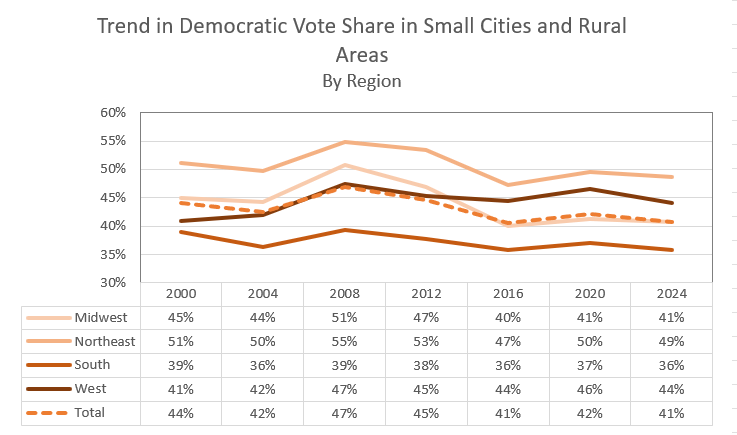
Democratic underperformance in cities and suburbs, particularly in the South and Midwest, was only made worse by a small town electorate that has swung overwhelmingly Republican since 2016. In every election with Trump on the ballot, he has won voters in towns and small cities (think Erie, PA) by a 6-to-4 margin. Outside of a few big cities, mostly clustered on either coast, Republicans have dominated.
Trump defies demographic destiny.
Democratic defeat in small town America is old news, but what stands out about this last election is the erosion of support in the urban core, especially among millennials, Latinos, Asians, and those living in high poverty neighborhoods. Shockingly, Harris just barely won people 30 to 44 years old, compared to a greater than 6-to-4 margin in favor of Obama among roughly the same millennials in 2012.
The low margins and turnout among voters of color likely explain much of this drop off with millennials. The Latino vote for Democrats fell from 71 percent for Obama to 51 percent for Harris, and Asian support dropped from 73 percent to 55 percent. And that doesn’t even fully factor in people who chose to sit out this election, a pattern seen in Black, Latino, and working class neighborhoods alike.
A geographic breakdown of electoral trends spells out a Democratic collapse in diverse, working class areas (see chart below). In just the eight years from 2016 to 2024, Democrats lost ground in Miami (-12%), Los Angeles (-7%), New York (-6%), Bay Area (-6%), Chicago (-5%), Honolulu (-5%), and Las Vegas (-4%). In communities as varied as Queens, Miami-Dade, Alameda, and Orange County, Democrats received hundreds of thousands fewer votes than they had in 2020.
What these areas have in common is that they are home to many Latino, Asian, and less-than-college-educated, working class voters. More in-depth news reports, have widely shown that these swings toward Trump were driven by frustrations and resentment among those in historically high-poverty, high-immigrant communities.
Interactive chart of voter shifts by metropolitan area. View here.

It’s (mostly) about education, not race or gender.
The final fallacy I want to dispel is that Trump’s win was powered by misogynous men, and a gaping gender gap. To be sure, there’s people who didn’t vote for Harris because she is a woman, or because she is Black, or both. And Trump was able to gin up support among young men, in a way that wouldn’t have been thinkable twenty years ago.
But, if you consider the big picture trends, voting patterns increasingly fall along class, educational, and cultural lines, with gender and race slowly fading into the background. In comparison with Hilary Clinton and Obama, Harris did reasonably well with men, especially considering the bad overall cycle for Democrats. She won 43 percent of men and 38 percent of white men. That’s not too far off from the 45 percent and 41 percent, respectively, that Obama won in 2012.
The other side of the coin is that white women have failed to show up for Democrats, election after election. They are the largest part of the electorate and have the power to see a woman into the White House. And yet, Trump won white women by between 7 and 11 points in the last three elections.
What’s really changed in the last 25 years is the precipitous march of less-than-college-educated voters into the Republican Party. Obama won non-college-educated voters (mostly people of color) in 2012, but Harris lost those same voters by double-digits in 2024. In fact, one reason Harris lost white women was that she lost white women, with no college degree, by a 2-to-1 margin.

What’s next?
My next post will focus on the root causes of our nation’s toxic political climate. I’ll unpack the underlying conditions that water down and discredit leftist politics, and that paradoxically, lure people into zealotry and cultural tribalism.
Dissecting Democratic Defeat Blog Series
Part I: 25 Years Mired in Stalemate
Part III: Where Did We Go Wrong?
Part IV: Where Do We Go From Here?
 My Millennium Commentary
3 responses to “Dissecting Democratic Defeat Part II: A Full-Blown Trouncing”
[…] Part II: A Full-Blown Trouncing […]
LikeLike
[…] of America as racist and sexist. Although these roadblocks may lessen liberal electoral chances, the data overwhelmingly show they were not the decisive factors in […]
LikeLike
[…] job governing and earning the trust of voters. The steepest drop-offs in Democratic support came in urban cores in 2024, especially within higher poverty neighborhoods. People are tired of the blight, crime, […]
LikeLike